Payout tables and the difference between odds and payouts
Posted 12 April 2007 at 09:14
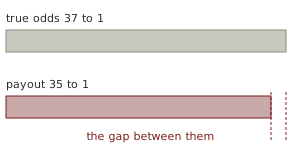
Two numbers sit beside every wager on a table layout, and they are not the same number. The first describes how often an outcome arrives if the game is played a very large number of times. The second describes what is handed back on the occasions when it does arrive. Almost every question about a casino game reduces to comparing those two numbers, and almost every confusion about one comes from reading them as though they were interchangeable.
Take a single number on a thirty-eight pocket wheel. The outcome arrives, in the long run, once in thirty-eight spins. The true odds against it are therefore thirty-seven to one. The payout offered is thirty-five to one. Nothing about that is concealed; it is printed on the felt and stated in every rule card. The two numbers simply differ, and the difference is where the arrangement lives.
It helps to write the comparison out rather than to feel for it. If a unit is staked on the same number for thirty-eight spins, the expected return is thirty-seven losing units against one winning unit that pays thirty-five, plus the staked unit returned. Thirty-six units come back where thirty-eight went out. The shortfall is two units in thirty-eight, which is a little over five in a hundred. That figure does not depend on how the spins are ordered, how recently the number appeared, or how the unit was chosen.
The same subtraction works on every wager in every game, which is why it is worth doing once slowly rather than repeatedly in a hurry. Write the frequency of the outcome as a fraction. Write the payout as a multiple of the stake. Multiply, subtract the stake, and the number that remains is the expected result of one unit staked. A payout that matches the true odds gives zero. A payout shorter than the true odds gives a negative number, and the size of that number is the size of the gap.
The reason the two numbers are so easily conflated is that they are written in the same grammar. Thirty-five to one and thirty-seven to one look like the same kind of statement, and in isolation each one is unremarkable. It is only when they are set against each other that the arithmetic becomes visible. That is the small habit this journal keeps returning to: read the frequency and the payout as a pair, never one at a time.
Posted in Probability | Permalink